
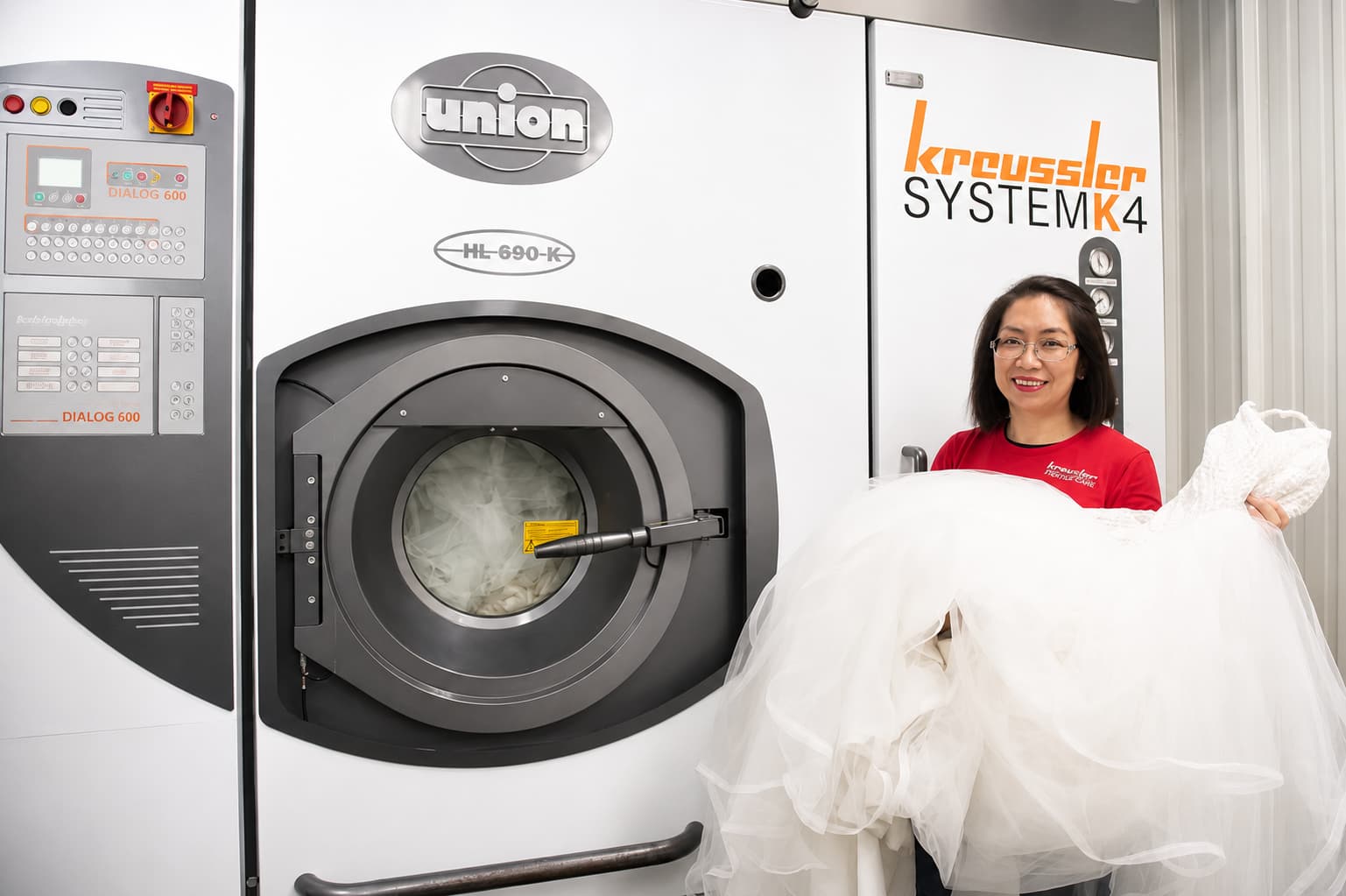
Your wedding dress is the most delicate — and most irreplaceable — thing you’ll ever own. Silk, lace, tulle, hand-set beading: every piece is built for beauty, not durability. And every invisible stain from the day, from a champagne toast to the perspiration along the bodice, is a slow chemistry experiment that will damage the fabric over time if it’s left untreated. So we don’t clean it like an ordinary garment. We use technology engineered for heirloom textiles — the same system museum curators trust to preserve ceremonial dresses for generations.
Why Standard Dry Cleaning Isn’t Built for Wedding Dresses
Standard dry cleaning is a general-purpose process — designed for everyday garments, not the delicate fabrics found in wedding dresses. Many dry cleaners still use perchloroethylene, or PERC — a solvent classified as a probable human carcinogen by the U.S. EPA. Even dry cleaners who have moved away from PERC typically aren’t trained or equipped to handle the specific fabrics and stains that wedding dresses present: silk, lace, tulle, chiffon, organza, satin, and hand-set beading all require a fundamentally different approach than a standard cleaning cycle can deliver.
For a delicate wedding dress, PERC and other harsh solvents create problems that may not show up until years later:
- They react with sugar residues left on the fabric (cake icing, champagne, fruit) and accelerate yellowing
- They can dissolve the adhesives holding beads, sequins, and crystals in place
- They’re harsh enough on delicate fibers that repeated exposure shortens silk and lace lifespan
- PERC is classified as a probable human carcinogen by the U.S. EPA, which is why dry cleaners pay an environmental tax to use it
While these issues may not be a concern for everyday clothing, they are much more concerning when it comes to ensuring the proper care of your precious and delicate wedding dress — care that should protect it for generations to come.
SYSTEMK4 — Cleaning Engineered for Heirloom Textiles
Gentle, non-toxic, and remarkably effective.
SYSTEMK4 was developed in Germany by Kreussler Inc., a chemical research firm founded in 1912 with more than a century of textile science behind it. The goal wasn’t to make dry cleaning cheaper or faster — it was to make it gentler, more effective on the stains that matter for archival textiles, and safer for the people who use it. All SYSTEMK4 solvents are eco-friendly, non-toxic, and biodegradable — engineered to be as responsible as they are effective.
Museum conservation labs adopted it almost immediately. Curators preserving historic ceremonial robes, military uniforms, and antique dresses needed a technology that could lift centuries of accumulated stains without damaging fabric structure or color. SYSTEMK4 met that bar and then some — and we use the exact same technology, to the exact same standards, on every wedding dress that comes through our facility.
The difference between SYSTEMK4 and PERC, as well as other harsh chemicals commonly used by dry cleaners, isn’t marketing — it’s measurable chemistry. SYSTEMK4 delivers better stain removal on the stains that matter most for wedding dresses (sugar, perspiration, oils), zero residue left on the fabric, full biodegradability, and a dermatologically tested safety profile that means no reaction even on the most delicate beadwork.
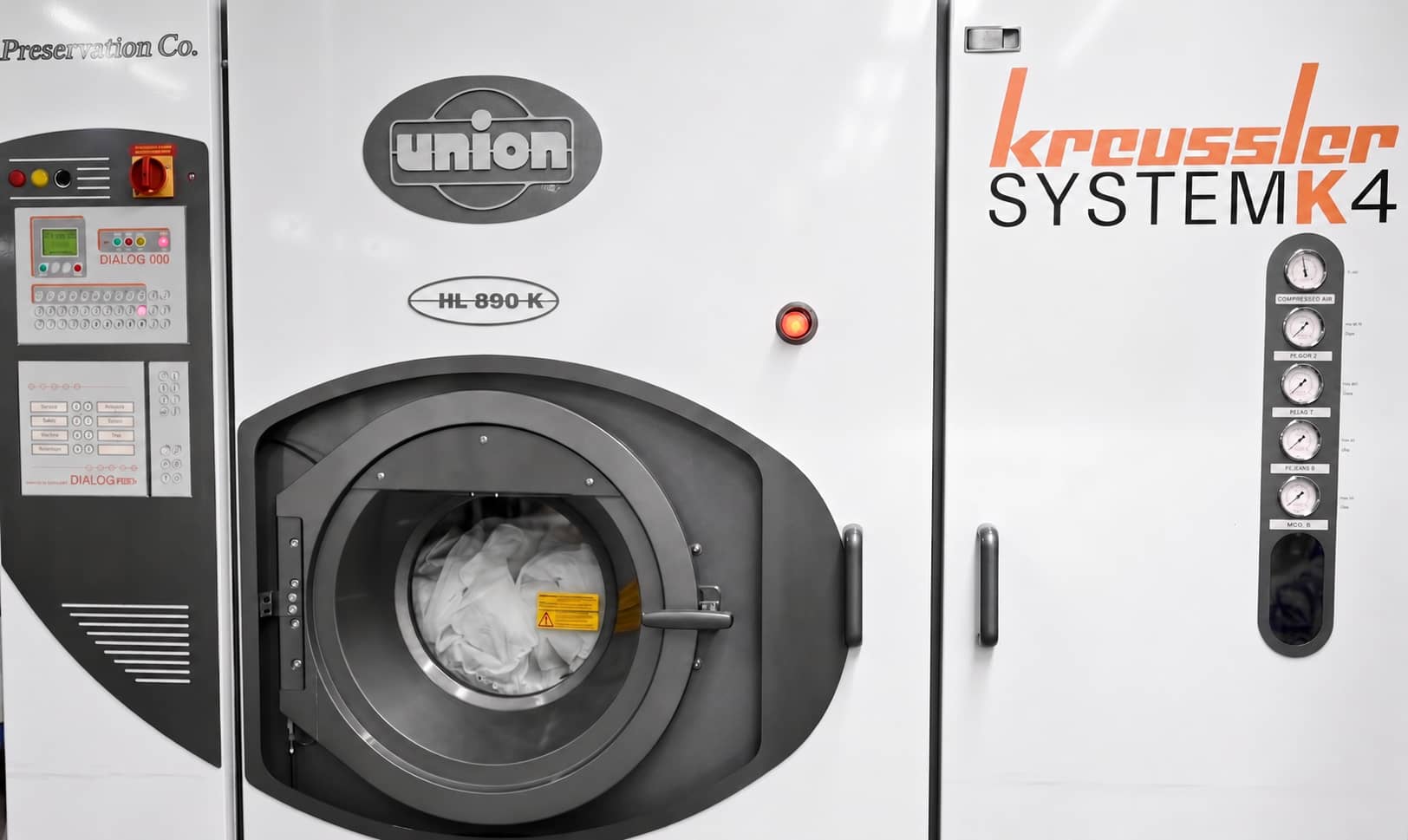
How SYSTEMK4 Works — 3 Specialized Solutions for Wedding Dress Cleaning
SYSTEMK4 isn’t a single solvent — it’s a coordinated system of three specialized solutions. Each one was engineered to handle a specific type of stain or fabric condition, and they’re used in sequence by trained technicians during your dress’s cleaning cycle.
SolvonK4
The base solvent — a halogen-free, biodegradable hydrocarbon that does the heavy lifting. Not classified as a hazardous material or hazardous substance. Gentle on silk, lace, tulle, and beading. Dermatologically tested and approved. Leaves no residue or chemical odor.
The foundation of the system — every other component is built on top of it.
ClipK4
A highly concentrated detergent designed for the invisible stains that ruin wedding dresses over time: perspiration residue, natural skin oils, sugar deposits, and other residues that haven’t oxidized yet.
This is what catches the stains that PERC and other harsh dry cleaning chemicals miss entirely.
PrenettK4
A targeted, gentle brushing agent for deep-set or stubborn stains — dirt, tar, and ground-in soil along the hemline, or stubborn food and beverage stains elsewhere on the dress. Used by hand on specific areas before the main cleaning bath.
Reserved for spots that need direct yet gentle intervention.
The full sequence: a technician inspects your dress under UV light to identify invisible stains, hand-treats stubborn spots with PrenettK4, applies ClipK4 to lift residual stains, then runs the cleaning bath in SolvonK4 under careful temperature and agitation control. Every step is monitored, documented, and fine-tuned to your specific dress’s fabric and construction.
Archival Packaging: The Other Half of 100-Year Preservation
Cleaning is half the story. The other half is what happens after — how your dress is stored, what materials touch it, and how it’s protected from the slow environmental damage of light, oxygen, and acid. Cleaning a dress perfectly and then sealing it in ordinary cardboard would undo most of the work within a few years.
The preservation chest and the materials inside it are engineered to the same standard as museum textile archives:
Acid-free preservation chest
The chest itself is built from materials that don’t off-gas acids over time. Standard cardboard, particle board, and many plastics release acidic vapors as they age — vapors that yellow fabric, weaken fibers, and accelerate stain oxidation. Our chests use the same archival-grade materials that protect historic uniforms and dresses in museum collections.
UV-protective viewing window
The clear oval window on the front of the chest is treated to filter ultraviolet light. Sunlight is one of the biggest sources of yellowing in stored textiles — the UV-protective treatment means you can display your preserved dress without the chest itself driving fabric breakdown.
Acid-free bust form
Your dress is fitted onto a contoured bust form so it holds its silhouette through long-term storage. The bust form is built from acid-free materials that won’t leach into the fabric over time. Without proper support, dresses can develop permanent creases and structural distortion.
Acid-free packaging materials
The tissue packed around your dress and between layers is acid-free archival tissue — the same type used to wrap historic textiles in museum storage. The chest is closed against dust but intentionally not airtight, because fabric needs to breathe.
Together, the cleaning system and the archival packaging are what make our 100-year guarantee against yellowing possible. Either one alone wouldn’t be enough.

Why Museums Trust This Technology
The textile conservation community is conservative by nature — understandable when you’re responsible for irreplaceable historic pieces. New technologies have to clear a high bar before they’re adopted in museum collections. SYSTEMK4 cleared that bar more than a decade ago. Today it’s used in:
- Historic ceremonial dress conservation
- Military uniform and regalia preservation
- Religious vestment archival cleaning
- Antique textile restoration projects
- Museum-quality dry cleaning for items entering permanent collections
The technology that protects museum textiles for centuries is the same technology we use on your wedding dress. The standards don’t change. The science doesn’t change. Only the dress does.
What This Means for Your Wedding Dress
If you’re comparing services or weighing whether proper preservation is worth it, here’s the practical impact of choosing museum-quality technology over your local dry cleaner:
- Invisible stains are caught and removed — perspiration residue, natural skin oils, sugar deposits, and other residues that won’t show until they’ve already yellowed.
- Safe on every delicate fabric — silk, lace, tulle, organza, illusion, and structured satin all get the same gentle treatment
- No chemical residue or odor — your dress comes back smelling like nothing, which is exactly what you want
- Eco-friendly, non-toxic, and biodegradable — no carcinogen exposure, no harsh chemical residue.
- Removes odors entirely — including smoke, perfume, and food smells the dress picked up at the reception
- Long-term yellowing protection — the combined cleaning and archival acid-free packaging materials are what enable the 100-year guarantee.
- Color and brightness preserved — whites stay white, ivories stay ivory, no fading or shifting
Every dress we receive goes through the same protocol. There’s no premium upgrade for specialty cleaning — SYSTEMK4 is what we use on every dress, whether it cost $400 or $20,000. The price tag doesn’t matter. The fabric does — and we’ve built our entire process around that.
If your dress has already yellowed or is more than 20 years old, our Wedding Dress Restoration service is built specifically for aged textiles. For the full step-by-step on how we clean your dress, the Wedding Dress Cleaning page walks through each stage.